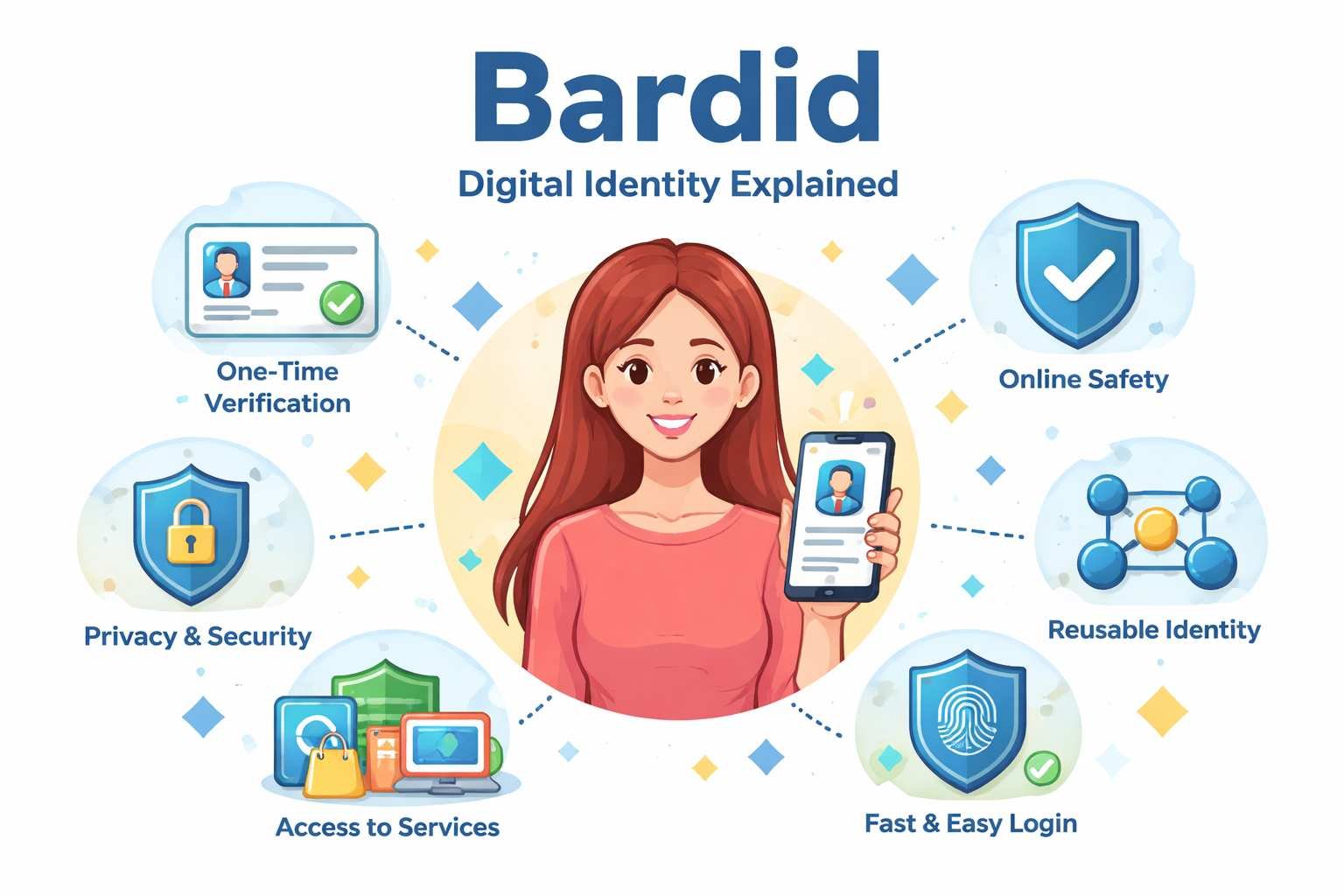
In today’s online world, we use the internet for almost everything: banking, shopping, studying, working, and talking to people. For all these activities, we need to prove who we are. This is called digital identity. Many websites ask us to sign up again and again, upload documents again and again, and share personal details again and again. This can be slow, annoying, and unsafe.
The word “Bardid” is often used to talk about a new way of handling digital identity. Bardid does not have one fixed meaning in the dictionary. Instead, it is a flexible term that is used to describe modern digital identity ideas, systems, or platforms. This article explains Bardid in simple words, using lists and tables.
1. What Is Bardid?
Bardid is not a common English word. It is used in different ways depending on the context.
Main meanings of Bardid:
-
A digital identity system or idea
-
A name for a technology product or platform
-
A surname or personal name in some cases
Most of the time, Bardid is used to mean a digital identity solution. This means a system that helps people prove who they are online in a safe and easy way.
2. Why Do We Need Better Digital Identity?
Today, people face many problems with online identity.
Common problems with current systems:
-
You must create many accounts on many websites
-
You must upload the same documents many times
-
Your personal data is stored in many places
-
Data leaks and hacks are common
-
The process is slow and frustrating
Table 1: Old Identity System vs Bardid-Style System
| Topic | Old Way (Traditional) | Bardid-Style Way (New) |
|---|---|---|
| Verification | Again and again on each website | One-time verification |
| Data sharing | Full data shared many times | Only needed data is shared |
| User experience | Slow and annoying | Fast and simple |
| Privacy | Weak protection | Strong privacy focus |
| Risk of data leaks | High | Lower |
3. How Does a Bardid-Style System Work?
A Bardid-style digital identity system has a few simple steps.
Step 1: Verify Once
The user proves their identity one time.
Ways to verify identity:
-
Uploading an ID card or passport
-
Face or fingerprint scan
-
One-time password or two-step login
Step 2: Get a Digital Identity
After verification, the user gets a digital identity that can be used again.
Step 3: Reuse the Identity
The same digital identity can be used on many websites without repeating the full process.
Read also: Rosboxar
4. Main Features of Bardid
Key features:
-
One-time identity check
-
Reusable digital identity
-
Secure login
-
Data protection
-
User control over shared data
Benefits for users:
-
Less time wasted
-
Less document uploading
-
More privacy
-
Better online safety
-
Easy access to services
Benefits for businesses:
-
Faster user sign-up
-
Less fraud
-
Lower costs
-
Better trust from users
5. Where Can Bardid Be Used?
Bardid-style digital identity systems can be used in many fields.
Table 2: Uses of Bardid by Industry
| Area | Example Uses | Benefits |
|---|---|---|
| Banking | Account opening, KYC checks | Faster service, less fraud |
| Healthcare | Patient login, medical record access | Secure access, privacy |
| Online shops | Verified buyers and sellers | Less scams, more trust |
| Education | Student ID, online exams | Easy verification |
| Government | Online public services | Simple access, less paperwork |
| Jobs | Proof of identity and skills | Faster hiring process |
6. Bardid as a Business and Innovation Idea
Sometimes Bardid is used not just as a technical tool, but as a business idea or innovation model. In this meaning, Bardid stands for:
Simple ideas behind this approach:
-
Building trust between users and systems
-
Connecting different digital services
-
Planning for safety and risk
-
Creating smooth digital experiences
This shows that identity is not only a technical issue, but also a business and social issue.
7. Why the Name “Bardid” Is Useful
The name Bardid is often chosen because it is:
Why people use names like Bardid:
-
Short and easy to remember
-
Rare and unique
-
Easy to use as a brand name
-
Not limited to one meaning
Table 3: Why New Names Are Popular in Tech
| Reason | Benefit |
|---|---|
| Easy to remember | Users recall it easily |
| Unique | Stands out from other brands |
| Flexible meaning | Can grow with the product |
| Branding friendly | Works well for startups |
8. Problems and Risks of Bardid-Style Systems
No system is perfect. Bardid-style digital identity systems also have risks.
Main risks and concerns:
-
Central control over identity
-
Possible misuse for tracking people
-
Errors in face or fingerprint checks
-
Some people may not have access to tech
-
Risk of system failures
Table 4: Risks and How to Reduce Them
| Risk | Possible Solution |
|---|---|
| Data leaks | Strong security and encryption |
| Privacy concerns | Share only needed information |
| Bias in biometric checks | Improve testing and fairness |
| Digital exclusion | Offer other ways to verify |
| System dependency | Use open standards and backups |
9. The Future of Bardid and Digital Identity
Digital identity systems will continue to grow and improve.
Future trends:
-
More user control over identity
-
Use of blockchain for security
-
Smarter fraud detection with AI
-
Shared identity standards between platforms
-
Stronger privacy laws
Table 5: Future of Digital Identity
| Trend | What It Means |
|---|---|
| Decentralized ID | Users control their own identity |
| Blockchain | Harder to change or fake records |
| AI checks | Faster and smarter verification |
| New laws | Better protection for users |
| Interoperability | One identity works on many platforms |
10. Conclusion
Bardid is a flexible term that is often used to describe modern digital identity systems. It focuses on:
-
One-time identity checks
-
Reusing the same identity on many websites
-
Strong privacy and security
-
Better user experience
Even though Bardid does not have one fixed meaning, the ideas behind it are important for the future of the internet. As more services move online, people need safe, simple, and private ways to prove who they are. Bardid-style systems point toward a future where online identity is easier to manage, safer to use, and more respectful of personal data.