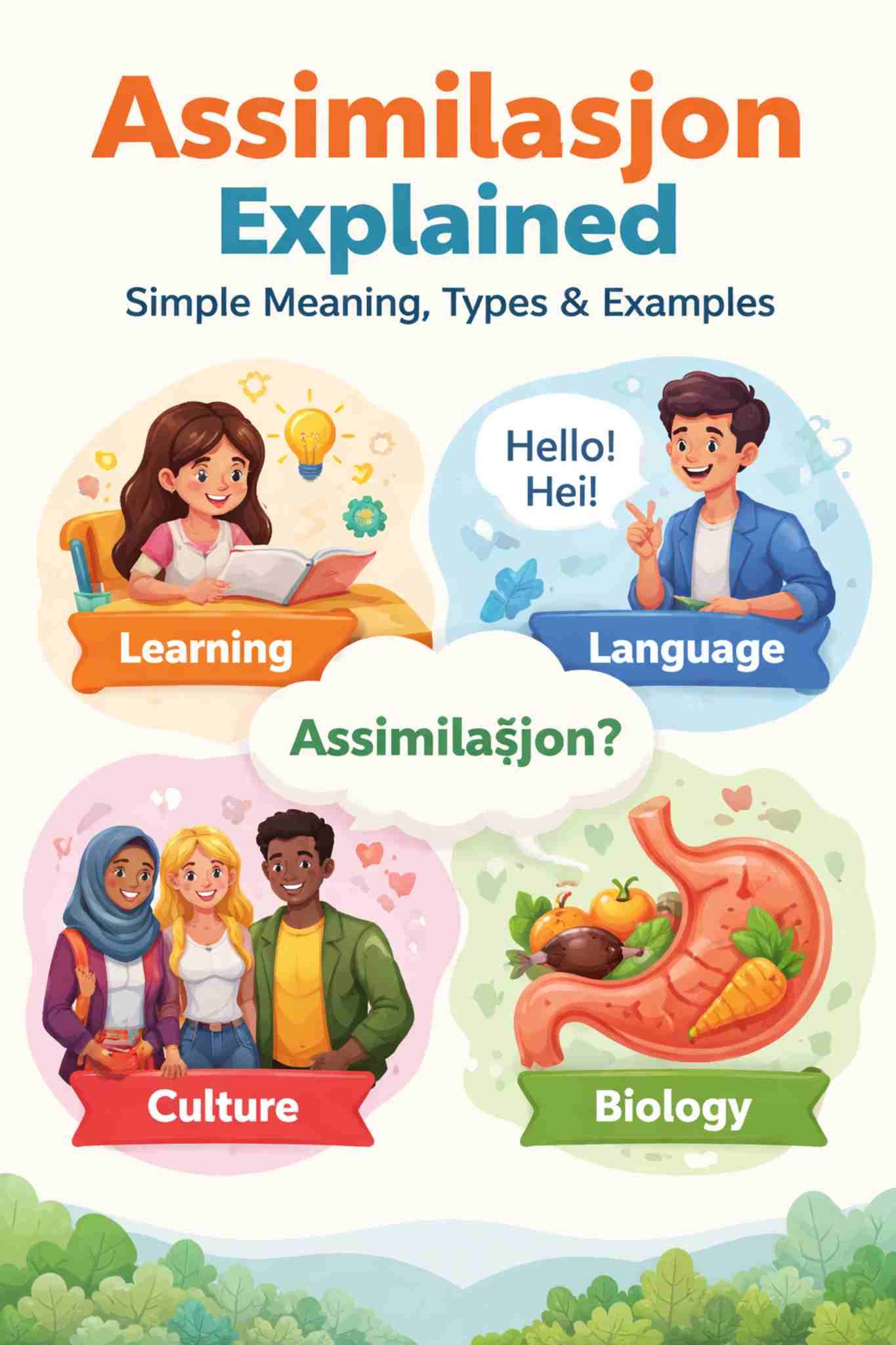
The word assimilasjon is used in many subjects, such as psychology, language studies, biology, and social studies. Even though the word is the same, it can have different meanings. In general, assimilation means that something new becomes similar to something that already exists. It is a process of change and adaptation.
We can see assimilation in everyday life, for example:
-
A student understands new information by using what they already know.
-
A person starts to speak more like the people around them.
-
A migrant slowly learns the language and habits of a new country.
These examples show that assimilation is about fitting in. Sometimes this can be helpful and natural. Other times, especially in society and politics, assimilation can cause problems. Some people may feel forced to change who they are in order to belong. This article explains what assimilasjon means, the different types of assimilation, how it is different from similar ideas, what causes it, and what effects it can have.
2. What Does Assimilasjon Mean?
In simple words, assimilation means:
-
Becoming similar to others
-
Fitting into something that already exists
-
Changing in order to belong
-
Adapting to new rules, habits, or ways of thinking
Assimilation can happen in different ways:
-
It can be a choice, when people want to adapt.
-
It can happen because of pressure, when people feel they must adapt.
-
It can happen slowly over time, especially across generations.
The table below shows how assimilation is used in different fields:
| Field | Meaning of Assimilasjon | Simple Example |
|---|---|---|
| Psychology | Learning new things by using old ideas | A child thinks all animals are “dogs” |
| Language | Sounds become more alike | Words change when spoken fast |
| Society | Minority adopts majority culture | Immigrants using the main language |
| Biology | Body takes in and uses food | The body absorbs nutrients |
3. Types of Assimilasjon
3.1 Assimilasjon in Learning (Psychology)
In learning, assimilation means that people understand new things by using what they already know.
Main points:
-
New information is added to old ideas
-
Makes learning easier
-
Helps people understand new situations
-
Works together with change in thinking
Example:
-
A child who knows the word “dog” may call a cow a “dog” at first. The child is using an old idea to understand something new.
Read also: FastBridge Login
3.2 Assimilasjon in Language
In language, assimilation happens when sounds change to become more like nearby sounds. This makes speaking easier and faster.
Common types:
-
Sounds change because of nearby sounds
-
Words sound different when spoken quickly
-
Pronunciation changes over time
Why this happens:
-
It is easier for the mouth to move
-
People speak fast in daily life
-
Languages change naturally
3.3 Assimilasjon in Society and Culture
In society, assimilation means that people from a smaller group start to live more like the bigger group in the country or community.
Areas where social assimilation happens:
-
Language
-
Clothing
-
Food habits
-
Social rules
-
Values and traditions
Examples:
-
A family starts speaking mostly the main language of the country.
-
Children grow up with the same habits as most people in society.
Some people choose to assimilate. Others feel they must do it to be accepted.
3.4 Assimilasjon in Nature and the Body
Assimilation is also used in science and biology.
Examples:
-
The body takes in food and uses it for energy.
-
Plants take in carbon dioxide to grow.
-
Cells use new materials to build tissue.
This shows that assimilation is a general idea about taking in something new and making it part of an existing system.
4. Assimilasjon and Similar Ideas
Assimilation is often mixed up with other words. These words describe different ways groups live together in society.
| Concept | Simple Meaning | Main Idea |
|---|---|---|
| Assimilasjon | Becoming like the majority | Change to fit in |
| Integrasjon | Joining society but keeping identity | Belonging with difference |
| Segregering | Groups live apart | Separation |
| Marginalisering | Being pushed outside society | Exclusion |
Important differences:
-
Assimilation means changing to become like others.
-
Integration means joining society while keeping your culture.
-
Segregation means staying separate.
-
Marginalization means being left out.
5. Why Does Assimilasjon Happen?
Assimilation happens for many reasons.
Social reasons:
-
People want to belong
-
People want to avoid being treated badly
-
There is pressure to follow social rules
Economic reasons:
-
Better chances of getting a job
-
Better education opportunities
-
Easier communication at work
Political and cultural reasons:
-
School systems use the main language
-
Media shows one culture more than others
-
Laws and rules may expect people to adapt
6. Effects of Assimilasjon
6.1 Possible Positive Effects
Assimilation can have some positive effects:
-
Easier communication
-
Feeling part of society
-
Better chances in school and work
-
Shared social rules
6.2 Possible Negative Effects
Assimilation can also cause problems:
-
Loss of language and traditions
-
Feeling of losing identity
-
Stress from trying to fit in
-
Unequal power between groups
The table below shows both sides:
| Positive Effects | Negative Effects |
|---|---|
| Easier to join society | Loss of culture |
| Better communication | Identity problems |
| More opportunities | Pressure to change |
| Shared rules | Feeling forced to fit in |
7. Ethical and Political Questions
Assimilation raises important questions:
-
Is it fair to expect people to change their culture?
-
Should society change too, not only minorities?
-
How can cultures be protected?
Different views:
-
Some think assimilation creates unity.
-
Others think it removes cultural diversity.
-
Many support integration instead of full assimilation.
8. Assimilasjon Today
In today’s world, assimilation is shaped by:
-
Migration between countries
-
Social media and the internet
-
Mixing of cultures
-
Young people having more than one cultural identity
Many people today live with mixed identities instead of fully assimilating into one culture.
9. Conclusion
Assimilasjon means becoming similar or fitting into something that already exists. It is a natural process in learning, language, and biology. In society, however, assimilation is more complex. It can help people join social life, but it can also cause loss of culture and identity. Understanding assimilation helps us see how people adapt to change and why it is important to respect cultural differences while building shared communities.